Hollywood Is Not Content
As Paramount and Warner Bros. Discovery move toward becoming one, I keep thinking about the Hollywood I inherited — VHS, early Hulu, blockbusters, indie films, Sidney Poitier — and what we lose if art becomes nothing more than content.

There is a very specific kind of grief moving through Hollywood right now.
You hear it in conversations between actors waiting for auditions. You hear it from writers, grips, assistants, producers, drivers, makeup artists, executives and people who own the restaurants that used to be packed after wrap. You hear it whenever another company restructures, another show disappears, another department gets smaller, another person quietly admits they have not worked enough this year.
The fear is that Hollywood isn't simply changing.
The fear is that we are watching something disappear.
I understand that fear because I was born in the year 2000, which, in hindsight, might have been one of the strangest and most beautiful times to fall in love with entertainment.
My generation inherited everything at once.
I could watch Grease on VHS and then turn around and watch Saturday Night Live on that early version of Hulu where you only got a handful of free watches before it started telling you no.
I could think a giant summer movie was the coolest thing I had ever seen, get completely invested in Jersey Shore, and then discover some independent film made for almost nothing that changed the way I thought about acting.
None of those things felt contradictory.
It was all storytelling.
That is probably why I have such a hard time with the word content.
A movie isn't just content to me. A television show isn't content. A performance isn't content.
Those things are made by cinematographers obsessing over light, writers losing sleep over three lines of dialogue, actors doing take 19 because take 18 wasn't true enough, grips building something nobody watching will ever consciously notice, and editors staring at two frames and somehow knowing that one of them is wrong.
Those people aren't making units for a quarterly earnings report.
They're making something.
And my love for Hollywood has always been a love for those people.
The First Time Hollywood Felt Real to Me
I had my first real encounter with Hollywood in 2015.
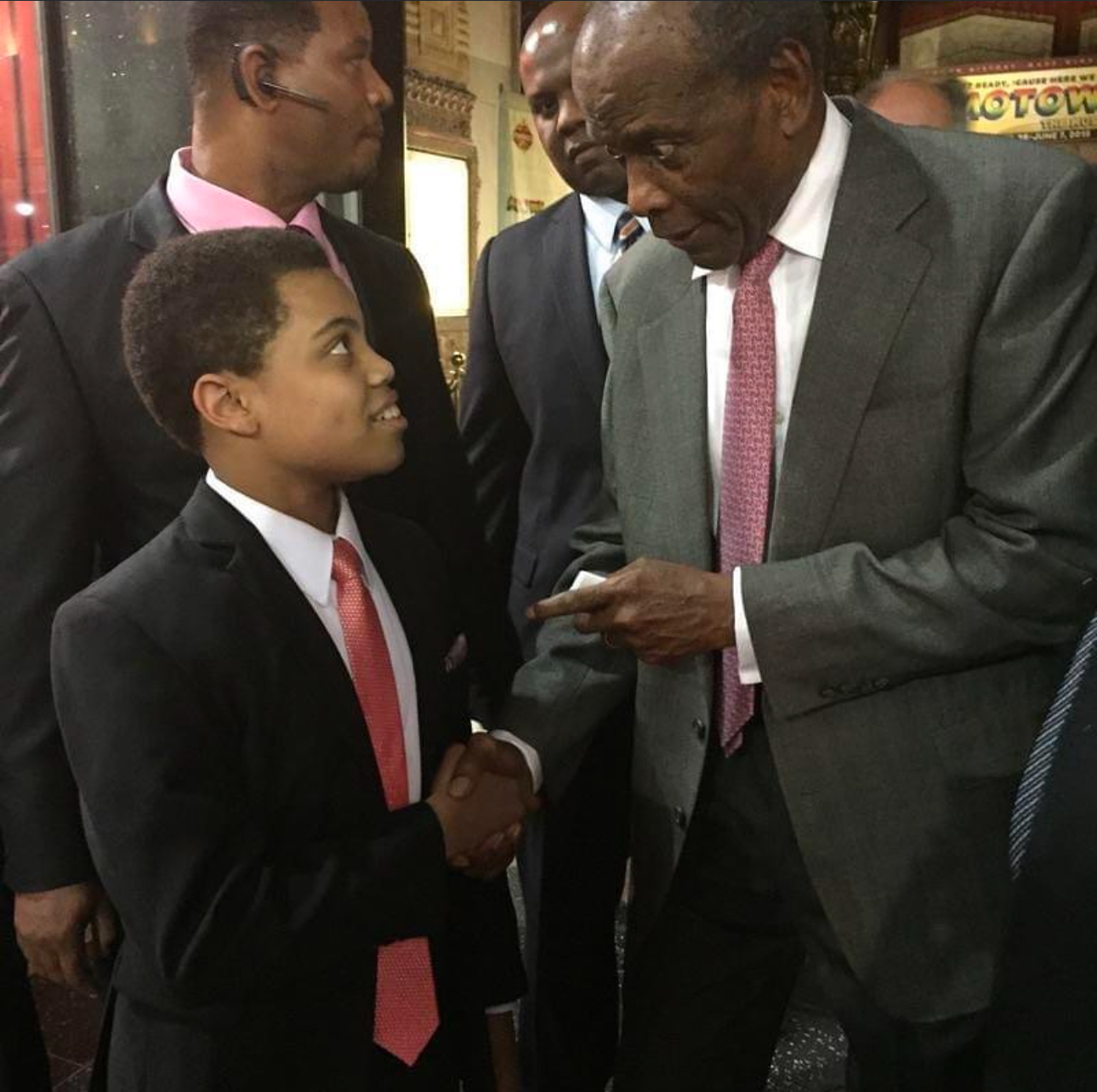
I was a kid performing as young Michael Jackson in the national tour of Motown The Musical. That year, the production came to the Pantages Theatre in Hollywood.
Outside the theater one night, I met Sidney Poitier.
I remember looking at him and realizing I wasn't looking at a movie star in the abstract anymore. This was a human being who had actually lived through the history I had been studying.
What I remember him telling me was to never stop creating. To be ruthless about the work. To always find the truth.
My eyes had never been wider.
For a kid who had spent his life dreaming about this business, Hollywood suddenly stopped being this mythical place on television.
It was right there.
And I don't think my story is unique.
Thousands of people in this city have some version of it.
The waitress who is also writing a pilot. The editor cutting a short after his actual shift ends. The actor who has heard "no" 300 times and is still preparing for number 301. The costume designer with sketches taped to a bedroom wall. The producer financing the first movie with money they probably should not be spending.
People come here because, against all evidence suggesting they should be more reasonable, they believe something extraordinary might happen.
Lately, it feels like those dreams are getting stomped out like a rival gang member who wandered onto the wrong block.
But here's the problem.
You can't stop a real gangster's hustle.
Hollywood has been trying to die for more than a hundred years.
It just keeps forgetting to.
Hollywood Has Always Been Changing
This town survived silent pictures becoming talkies.
It survived television coming into the living room.
It survived the collapse of the old studio system, cable television, home video, DVDs, reality television, YouTube, streaming and practically every new technology that was supposedly going to make the thing before it irrelevant.
Hollywood has never been a museum.
Change is part of the business.
What worries me is not change.
It's consolidation without enough consideration for the people who actually make the product being consolidated.
And that brings us to Paramount and Warner Bros. Discovery.
So What Is Actually Happening?
Paramount Skydance has agreed to acquire Warner Bros. Discovery in one of the largest media transactions Hollywood has ever seen.
The proposed transaction values Warner Bros. Discovery at roughly $110 billion in enterprise value.
And as of this week, the story moved again.
On September 17, the Federal Communications Commission approved the foreign-investment structure associated with the transaction. Paramount has said it has now satisfied the regulatory closing conditions required under the merger agreement after receiving clearances across dozens of jurisdictions around the world.
But that does not mean the merger is complete.
The Writers Guild of America and a coalition of 12 state attorneys general are challenging the transaction on antitrust grounds. Paramount and Warner Bros. Discovery have agreed to keep the transaction on hold pending that litigation or until June 1, 2027, whichever comes first.
The WGA argues that combining the companies would reduce competition for writers and could mean fewer employment opportunities, fewer productions and downward pressure on compensation.
Those are allegations being litigated, not established findings.
Paramount strongly disputes that characterization. The company argues that combining the businesses will strengthen competition, investment and its ability to compete globally.
So there are competing arguments here.
- Paramount argues that greater scale can help a traditional Hollywood company compete in a global entertainment market increasingly shaped by enormous technology platforms.
- The WGA and the states challenging the transaction argue that greater consolidation could reduce competition and opportunities within the entertainment industry.
- SAG-AFTRA has said it opposes the acquisition absent enforceable guarantees protecting and expanding production.
That distinction matters.
There is a business argument being made for this merger.
There is a labor and antitrust argument being made against it.
And somewhere between those two arguments are thousands of people wondering whether they're going to have a job.
For the latest regulatory development, see Reuters' September 17 report on the FCC approval. Paramount's position can be read in its regulatory clearance announcement. The WGA has published its case against the transaction, while SAG-AFTRA has published its position on the Paramount-Warner Bros. transaction.
"Synergy" Sounds Different When It's Your Paycheck
This is where corporate language and human language start speaking past each other.
Companies talk about efficiency.
Workers talk about employment.
Companies talk about consolidation.
Artists talk about opportunity.
Companies talk about synergies.
A crew member talks about whether there will actually be another season.
I understand why workers are skeptical.
SAG-AFTRA's National Board has publicly opposed the acquisition absent enforceable guarantees of continued and expanded production, while supporting the legal challenges brought by the state attorneys general and the WGA.
The WGA has gone further and is itself suing to block the transaction.
Different unions and organizations may pursue different strategies.
Solidarity does not require everybody to use the exact same strategy.
It requires remembering who is carrying the cameras when the corporate strategy meetings are over.
You cannot save Hollywood by removing everybody who knows how to make Hollywood.
This Is Where I Become Both an Entertainer and an Entrepreneur
This entire situation leaves two different sides of me arguing with each other.
The entrepreneur in me understands consolidation.
I understand scale.
I understand looking at five departments doing something that could theoretically be done by two and asking why you're paying for five.
I understand margins.
I understand debt.
I understand that sentimentality is not a business model.
But then the entertainer in me looks around and asks:
At what point did efficiency become the only thing we were trying to create?
Because I don't understand how the pursuit of money becomes so powerful that human beings, institutional knowledge and culture begin looking disposable.
Maybe that's something I'll understand when I'm older.
Maybe that's youth.
Maybe it's naïveté.
I'm 25. There are people running these corporations who have forgotten more about finance than I currently know.
But I know what a good movie feels like.
I know what happens when a crew believes in something.
I know what it feels like to walk onto a set and realize 100 people have brought completely different skills together to make a moment that might last eight seconds on screen.
And I know that you cannot manufacture that from an earnings call.
The People Behind the Industry
That is why this conversation has to include labor.
- SAG-AFTRA
- Writers Guild of America West and East
- IATSE and its crafts
- Directors Guild of America
- American Federation of Musicians
- Teamsters
- Hollywood Basic Crafts
Different organizations. Different jurisdictions. Sometimes different strategies.
One industry.
I'm proud to stand with the workers fighting to make sure the next version of Hollywood still has room for the human beings who create it.
Not because corporations are inherently evil.
They're not.
Not because change should stop.
It can't.
But because somebody has to keep reminding the people making decisions about entertainment that entertainment is made by people.
I Still Believe in Hollywood
And this is where I refuse to write the obituary.
I don't believe the answer is pretending old Hollywood was perfect.
It wasn't.
There are people who were excluded from that supposedly golden system who are only now beginning to get the opportunity to tell their stories.
There are filmmakers making incredible movies with cameras that would have looked like science fiction 30 years ago.
There are kids building audiences from their bedrooms.
There are independent producers who no longer need permission from five people in an office tower to prove somebody wants to hear what they have to say.
Some of the disruption has been incredible.
I just don't believe progress requires destroying the craft that got us here.
When I met Sidney Poitier outside that theater in 2015, I don't remember thinking about market capitalization.
I remember thinking:
I want to do this for the rest of my life.
Eleven years later, I still do.
Whatever Paramount becomes.
Whatever happens to Warner Bros.
Whatever platform replaces the platform we're all currently complaining about.
Whatever somebody decides to call the next version of this business.
I'm going to make things.
A movie.
A television show.
A song.
A short film.
A story somebody watches on a six-inch screen or a 70-foot one.
Because Hollywood was never actually a collection of buildings.
It wasn't Paramount's gates.
It wasn't the Warner Bros. water tower.
It wasn't even that sign sitting in the hills.
Those things are symbols.
Hollywood is the irrational belief shared by thousands of people that somebody can imagine something that doesn't exist, gather a bunch of other people crazy enough to believe in it too, and somehow turn it into two hours in the dark that make a stranger feel something.
You can't merge that. You can't offshore it. You can't put it into a spreadsheet. And you damn sure can't kill it by calling it content.
I believe in this city.
I believe in its workers.
I believe in the people still writing when nobody has bought the last script. The actors still preparing. The crews still waiting on the call. The filmmakers financing impossible movies. The musicians, designers, editors, assistants and entrepreneurs trying to build whatever comes next.
Maybe Hollywood as we knew it really is ending.
Fine.
We've ended before.
Then we built the next version.
I'll see you there.